Securing prestigious industry recognition can instantly elevate your brand credibility, attract top engineering talent, and unlock valuable investor interest. Learning how to apply for AI awards allows innovators to showcase their technological breakthroughs on a global stage. However, crafting a successful submission requires more than just filling out a standard online form. Preparing a standout AI awards application demands clear strategic messaging, verified data points, and a deep understanding of what judges evaluate.
Navigating the competitive award landscape requires significant effort, but the strategic benefits make every minute worth it. Understanding how to apply for AI awards systematically gives startups, enterprise teams, and individual researchers a distinct competitive edge. Winning an award positions your company as an industry benchmark and validates your hard work. This guide outlines the essential steps, strategies, and best practices you need to build a compelling entry that captures the attention of judging panels worldwide.
Before You Apply: Check If You’re Eligible
Before spending dozens of hours writing your submission, verify that your project satisfies every basic entry requirement. Industry organizers design specific categories for various organizations, including early-stage startups, global enterprise firms, academic research labs, and public sector institutions. Each category features strict criteria regarding project launch dates, geographic markets, and technical implementations. Reviewing the entry requirements carefully ensures your AI awards application targets the correct audience and aligns perfectly with the judges’ expectations. Selecting the wrong category will disqualify even the most impressive artificial intelligence solution.
Matching your core achievements to the right category dramatically increases your chances of advancing through the judging rounds. For instance, an enterprise deploying machine learning for supply chain optimization should focus on operational efficiency categories rather than consumer product innovation. Tailoring your AI awards application around the specific focus area of the category helps judges evaluate your entry against relevant industry benchmarks. Additionally, drafting a strong AI award nomination requires verifying that your team holds all intellectual property rights and necessary release permissions for the submitted data.
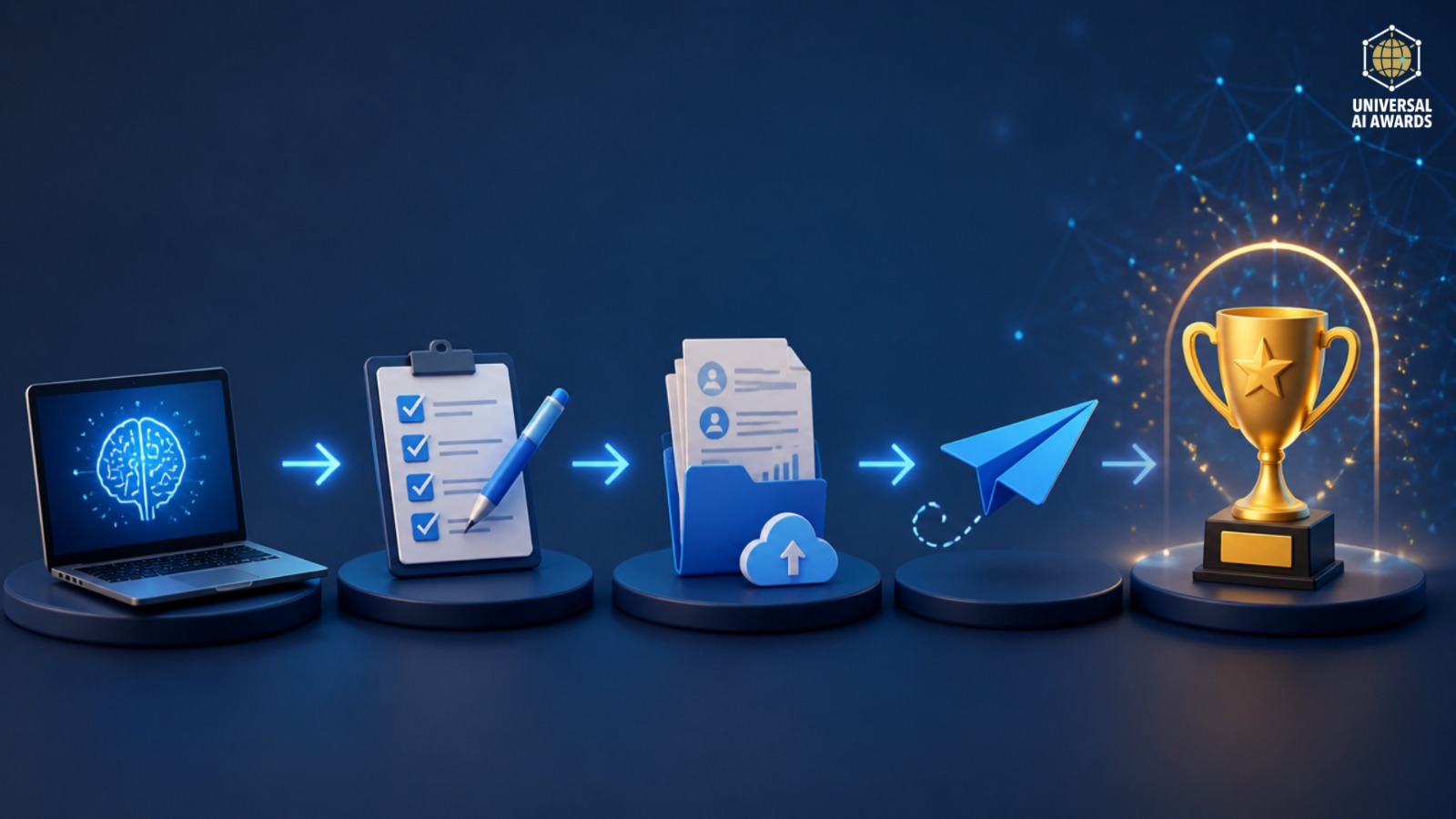
Step-by-Step Process to Apply for AI Awards
First, research reputable award programs that align with your industry domain, budget, and strategic goals. Focus on programs with transparent evaluation metrics and respected judging panels rather than pay-to-win platforms. Knowing how to apply for AI awards begins with selecting competitions that bring genuine industry prestige and targeted brand visibility to your organization.
Gather Supporting Documents and Verified Metrics
Next, gather concrete evidence to substantiate your claims long before the deadline approaches. Collect key performance indicators, user testimonials, third-party audit reports, and media coverage that prove real-world impact. Assembling these materials early streamlines your overall AI awards submission and prevents last-minute scrambling for missing data.
Write a Compelling Narrative
Transform technical specifications into a clear, engaging story that highlights a significant problem and your innovative solution. Explain the challenge your team faced, the unique artificial intelligence model you built, and the measurable business or social impact you generated. Drafting a powerful AI award nomination requires focusing on real outcomes rather than overly dense technical jargon.
Review Eligibility Criteria
Before finalizing your content, re-read the program rules to confirm full alignment with all eligibility guidelines. Ensure that your project launch date falls within the required eligibility window and that you answered every prompt completely. Double-checking these details protects your AI awards submission from immediate administrative rejection.
Submit Before the Deadline
Finally, submit your completed entry early to avoid technical glitches on the submission portal. Knowing how to apply for AI awards effectively means respecting deadlines and building in extra buffer time for internal legal and PR approvals. Submitting early allows you to review your final entry calmly and confirm that the organizers received all attachments.
What Makes an Award-Winning AI Award Nomination?
Winning submissions always focus heavily on real business impact and measurable outcomes. Judges evaluate hundreds of entries, so static feature lists rarely make a strong impression. A winning AI award nomination articulates clear quantitative metrics, such as percentage efficiency gains, cost reductions, revenue growth, or accelerated clinical trial timelines. Demonstrating a clear return on investment gives judging panels hard evidence of your solution’s tangible value.
Beyond numerical results, judges look for genuine technological innovation and responsible deployment practices. Highlighting unique algorithmic architectures, novel data processing methods, or ethical AI governance frameworks helps set your entry apart from standard market solutions. Integrating these elements into your AI awards application demonstrates that your team prioritizes both technical excellence and social responsibility. Furthermore, crafting an outstanding AI award nomination requires supporting every claim with clear third-party evidence, user case studies, or published research papers.
Common Mistakes That Lead to Rejected Applications
One of the most frequent errors applicants make is providing vague, generic answers that lack specific evidence. Submitting marketing fluff instead of concrete data immediately weakens your entry and frustrates judges who want hard facts. Failing to tailor your responses directly to the published judging criteria will sink your AI awards submission before judges even finish reading the first section. Always treat every prompt as a specific question that requires precise, evidence-backed answers.
Another major mistake involves waiting until the last minute to begin drafting your submission. Rush jobs consistently result in incomplete documentation, broken link attachments, unverified metrics, and unpolished writing. Following a comprehensive award application guide helps your team plan ahead, maintain proper quality control, and catch errors before final submission. Treating your AI awards submission as a serious strategic initiative ensures that your team submits a polished, error-free entry that reflects your true capabilities.
AI Awards Application Checklist Before You Submit
Before hitting the final submit button, execute a rigorous review process across your entire application package. Running through a structured award application guide checklist guarantees that you have met every requirement and eliminated unnecessary errors. Use the following operational checklist to verify your application readiness:
- Eligibility Confirmed: Verify that your project meets all timeline, geographic, and category requirements.
- Required Documents Attached: Ensure that all case study PDFs, product videos, slide decks, and data architecture diagrams upload correctly without broken links.
- Metrics Verified: Cross-check all financial percentages, user growth figures, and efficiency statistics with your internal analytics team for 100% accuracy.
- Proofread Nomination: Edit the text thoroughly to remove typos, passive voice constructions, and overly complex technical jargon.
- Submission Reviewed: Have an external colleague or legal editor read through the entire form to ensure clear formatting and tone before final sign-off.
Following a clear award application guide keeps your team organized and focused throughout the entire review stage. Mastering how to apply for AI awards ultimately comes down to careful preparation, relentless proofreading, and delivering verifiable proof of your achievements.
FAQs
1. Who can apply for AI awards?
Startups, enterprise companies, academic researchers, public sector agencies, and individual developers can all apply for artificial intelligence awards. Most award programs offer dedicated categories tailored to specific organizational sizes, industries, and project scopes.
2. What documents are required for an AI awards application?
Most programs require a completed online submission form, a detailed executive summary, technical architecture diagrams, customer case studies, and verified metrics. You may also attach product demonstration videos, media coverage, and client reference letters.
3. How are AI award nominations evaluated?
Judges evaluate entries based on published criteria, typically focusing on technological innovation, business impact, scalability, user experience, and responsible AI practices. Independent industry experts review and score each entry against these standardized benchmarks.
4. Can startups apply for AI awards?
Yes, startups can and should apply for industry awards. Many prestigious competitions feature specific categories for early-stage and seed-funded companies to showcase disruptive technology without competing against multi-billion-dollar enterprise budgets.
5. How long does the AI awards submission process take?
The entire process usually takes between 10 to 20 hours spread across several weeks. This timeline includes category selection, metric gathering, narrative drafting, internal legal review, and final online submission.
6. What increases the chances of winning an AI award?
Providing verified quantitative metrics, showing clear human or business impact, emphasizing ethical AI standards, and submitting polished, active-voice responses dramatically increase your winning chances. Supporting every claim with third-party proof also sets top entries apart.